
 Get Cracking Limited
3 Steps for a Successful Office Move in Dublin
3 Steps for a Successful Office Move in Dublin
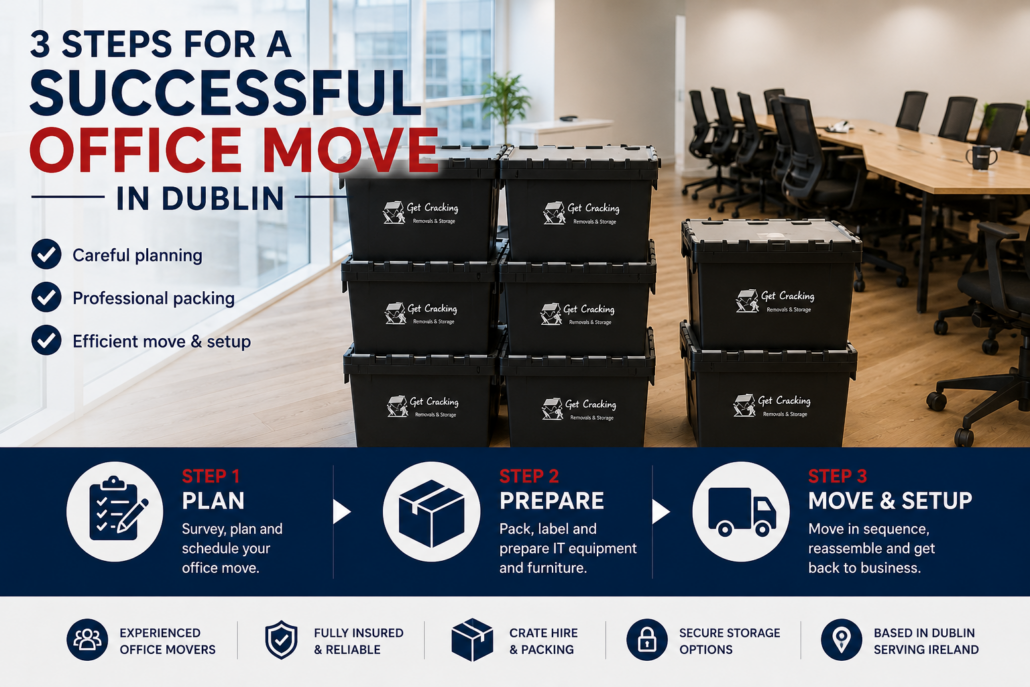
Plan, prepare and complete a successful office move in Dublin with professional office movers and crate hire.
Planning an office move in Dublin involves much more than moving desks and chairs from one building to another. A successful business relocation needs careful planning, clear communication, professional packing and a moving schedule designed to minimise disruption.
Whether you are moving a small office with 5 employees, a medium-sized business with 30 employees or a large office with 100+ staff, the objective is the same: move safely and efficiently while keeping business downtime to a minimum.
At Get Cracking, we provide professional office relocation services throughout Dublin and Ireland.
Here are the three key stages we recommend when planning a successful office move.
Step 1: Survey, Plan and Schedule Your Office Move
Good office removals in Dublin start with planning well before moving day.
The first step should be to assess exactly what needs to be moved and understand the access requirements at both your existing and new premises.
Your office moving plan should consider:
- Number of employees and workstations
- Desks, chairs and office furniture
- Computers and monitors
- Servers and IT equipment
- Filing cabinets and confidential documents
- Printers and photocopiers
- Artwork and fragile items
- Kitchen and staff-room equipment
- Storage requirements
- Parking and loading access
- Lifts and stairs
- Building management requirements
- Moving dates and permitted working hours
For larger commercial office relocations, a pre-move survey becomes particularly important.
Check Access and Parking Before Moving Day
Access problems can cause unnecessary delays, particularly with Dublin city-centre office moves.
Check loading bays, parking restrictions, lift dimensions, staircases, underground car parks and building access at both locations.
Dublin City Council states that loading bays have specific operating restrictions and that goods vehicles may generally use designated loading bays for a maximum of 30 minutes during the indicated hours. Businesses planning a city-centre relocation should check the Dublin City Council parking and loading guidance when preparing the move.
Your Get Cracking move coordinator can then plan the vehicles, crew and moving sequence around the available access.
Create a Floor Plan for the New Office
Don’t wait until the removal crew arrives to decide where everything should go.
Create a floor plan showing:
- Departments
- Workstations
- Meeting rooms
- IT areas
- Storage areas
- Reception
- Kitchens
- Filing areas
Numbering or colour-coding departments can make a substantial difference on moving day.
A crate marked “Accounts – A12”, for example, can be taken directly to the correct workstation instead of being left in a central area and moved again later.
Keep Employees Informed
Employees should know when the move is happening, what they are responsible for packing and when their existing workstation needs to be ready.
For larger offices, consider appointing a representative from each department to communicate with the person managing the relocation.
Step 2: Pack, Label and Prepare Your Office
Once the plan is established, preparation can begin.
An office relocation is also an excellent opportunity to decide what actually needs to move.
Old paperwork, obsolete equipment, broken furniture and unused items don’t necessarily need to occupy valuable space in your new office.
Protect Confidential Documents and Business Data
Be particularly careful when disposing of documents containing personal or confidential information.
The Irish Data Protection Commission advises organisations to securely dispose of paper records and effectively erase data stored electronically when equipment is being disposed of. You can read its Data Security Guidance before clearing out old office equipment and files.
Don’t simply throw confidential files into general waste because you’re moving office.
Professional Office Packing
Businesses can choose to pack themselves, use a professional packing service or combine the two.
For example, employees may pack personal desk contents while professional movers handle:
- Computers
- Monitors
- Office furniture
- Large printers
- Fragile equipment
- Artwork
- Filing systems
- Specialist equipment
Get Cracking can provide office moving crates and professional packing materials to prepare equipment for transportation.
Label Everything Clearly
Good labelling can save hours at the destination.
Instead of simply writing “Office” on a crate, use a system identifying exactly where it belongs.
For example:
Marketing – Desk M04 – New Office Floor 2
This allows the moving crew to position crates and equipment correctly as they arrive.
Prepare Computers and IT Equipment
IT should have its own relocation plan.
Before moving day:
- Back up important data
- Identify each employee’s computer and monitor
- Label cables where necessary
- Coordinate disconnection with your IT provider
- Identify servers and specialist equipment
- Establish which IT equipment needs to arrive first
Your IT team or provider should determine how sensitive equipment is disconnected and reconnected.
Dispose of Unwanted Electrical Equipment Correctly
Old monitors, computers and other electrical equipment shouldn’t simply be placed in general waste.
WEEE Ireland provides information on electrical and electronic recycling and has specific guidance relating to commercial/B2B electrical waste. Businesses replacing equipment during an office move can consult WEEE Ireland’s B2B recycling information for further guidance.
Office Furniture Dismantling
Large desks, boardroom tables, shelving and other furniture may need to be dismantled before transportation.
Get Cracking can assist with furniture dismantling and reassembly so that suitable items can be moved safely and rebuilt at the new premises.
Moving heavy office furniture also creates manual-handling risks. The Health and Safety Authority provides guidance on managing manual handling in transport and storage.
Step 3: Move, Reassemble and Get Back to Business
A successful office move in Dublin should follow a planned sequence.
This is particularly important for medium and large offices involving multiple departments, vehicles or moving phases.
Decide What Needs to Arrive First
Think about what your business needs in order to become operational.
For example, it may make sense for IT equipment and essential infrastructure to arrive before less important furniture.
Your sequence could be:
1. Essential IT and communications
2. Desks and workstations
3. Employee computers and monitors
4. Departmental crates and files
5. Meeting-room furniture
6. Kitchens, storage and non-essential equipment
The correct order will depend on your business.
Reassemble Office Furniture
Furniture can then be positioned according to your predetermined floor plan.
Desks, tables and shelving that were dismantled for transportation can be reassembled where required.
Having the destination layout agreed beforehand avoids spending valuable time moving furniture around after installation.
Complete a Final Walk through
Before finishing the relocation, check both premises.
Confirm that:
- All labelled items have arrived
- Furniture is in the correct departments
- Nothing remains at the old premises
- Important equipment is accounted for
- Surplus items have been identified
- Items requiring storage are separated
Once the physical move is complete, your IT provider and employees can concentrate on getting the business fully operational again.
Small, Medium or Large Office Move?
Not every office relocation requires the same approach.
A five-person business moving across Dublin has very different requirements from a company relocating 100 employees.
We generally recommend thinking about office moves in three broad categories.
Small Office Move – 1 to 20 Employees
A small office move in Dublin can often be relatively straightforward, but planning is still important.
A typical move might involve:
- Desks and office chairs
- Computers and monitors
- Filing cabinets
- Personal desk contents
- Small office equipment
- Meeting-room furniture
Crates can be delivered before the move so employees have time to pack appropriately.
For smaller businesses, the priority is usually completing the physical move efficiently so employees can resume work with minimal disruption.
Example
A 12-person company relocating from Dublin 2 to Dublin 4 may need its workstations, IT equipment, files and meeting-room furniture moved to the new premises.
With access, packing and the destination layout planned beforehand, the relocation can be organised far more efficiently.
Medium Office Move – 20 to 50 Employees
Once an office reaches approximately 20–50 employees, coordination becomes increasingly important.
A medium-sized office relocation may require:
- Detailed pre-move survey
- Department-by-department planning
- Crate management
- IT relocation planning
- Furniture dismantling
- Multiple loads
- Dedicated move supervision
- Colour-coded labelling
- Temporary storage
- Phased relocation
Businesses may also consider completing certain elements outside their busiest working periods where appropriate.
Example
A 40-person business relocating between two Dublin office buildings might divide the move into departments.
Accounts → Sales → Operations → Management
Each department’s crates, furniture and equipment can then be delivered to its predetermined location at the destination.
Large Office Move – 50+ Employees
A large office relocation should be approached as a commercial relocation project rather than simply a furniture move.
Planning may involve:
- Detailed site surveys
- Move management
- Multiple departments
- Floor plans
- Building management
- Security requirements
- Loading bay bookings
- Lift bookings
- Multiple crews
- Multiple vehicles
- IT and server coordination
- Specialist equipment
- Storage
- Phased moving
- Furniture installation
- Business continuity planning
The larger the organisation, the more important the sequencing becomes.
Moving everything simultaneously without a clear destination plan can create unnecessary downtime.
Office Storage During a Business Relocation
Sometimes everything cannot move directly from one office into another.
The new office might still be undergoing refurbishment, the business may be downsizing, or the relocation may be completed in phases.
Get Cracking can provide secure storage in Dublin for:
- Office furniture
- Files
- Equipment
- Crates
- Surplus desks
- Seasonal items
Storage can be incorporated into the overall relocation plan rather than treated as a separate move.
How Far in Advance Should You Plan an Office Move?
There isn’t one timetable that suits every business.
A small office relocation may require considerably less preparation than a multi-floor corporate move.
The important point is to contact your office removal company early enough to survey the premises and identify potential issues.
Factors such as restricted loading access, lift bookings, specialist equipment, IT infrastructure and building management requirements can all influence the schedule.
How to Minimise Business Downtime
Downtime is one of the biggest concerns when moving office.
The key is preparation.
Before moving day:
- Know where everything is going.
- Have crates labelled.
- Prepare the new office floor plan.
- Coordinate with your IT provider.
- Confirm access and parking.
- Inform building management.
- Establish the loading sequence.
- Identify essential equipment.
- Tell employees exactly what is expected of them.
The more decisions that are made beforehand, the fewer decisions need to be made while the removal crew is working.
Professional Office Removals Dublin
Whether you’re relocating 5 employees or 100+, every successful office move begins with a good plan.
Get Cracking provides professional office removals in Dublin, from small business relocations to larger commercial office moves.
Our services can include:
- Pre-move surveys
- Office packing
- Moving crates
- Furniture protection
- Office furniture dismantling and reassembly
- Transportation
- Storage
- Move planning
- Commercial relocations
Learn more about Get Cracking Office Relocations →
If you’re planning an office move in Dublin, contact Get Cracking to arrange a survey and discuss the requirements of your business relocation.
3 Steps for a Successful Office Move in Dublin
Planning an office move in Dublin involves much more than moving desks and chairs from one building to another. A successful business relocation needs careful planning, clear communication, professional packing and a moving schedule designed to minimise disruption.
Whether you are moving a small office with 5 employees, a medium-sized business with 30 employees or a large office with 100+ staff, the objective is the same: move safely and efficiently while keeping business downtime to a minimum.
At Get Cracking, we provide professional office relocation services throughout Dublin and Ireland.
Here are the three key stages we recommend when planning a successful office move.
Step 1: Survey, Plan and Schedule Your Office Move
Good office removals in Dublin start with planning well before moving day.
The first step should be to assess exactly what needs to be moved and understand the access requirements at both your existing and new premises.
Your office moving plan should consider:
Number of employees and workstations
Desks, chairs and office furniture
Computers and monitors
Servers and IT equipment
Filing cabinets and confidential documents
Printers and photocopiers
Artwork and fragile items
Kitchen and staff-room equipment
Storage requirements
Parking and loading access
Lifts and stairs
Building management requirements
Moving dates and permitted working hours
For larger commercial office relocations, a pre-move survey becomes particularly important.
Check Access and Parking Before Moving Day
Access problems can cause unnecessary delays, particularly with Dublin city-centre office moves.
Check loading bays, parking restrictions, lift dimensions, staircases, underground car parks and building access at both locations.
Dublin City Council states that loading bays have specific operating restrictions and that goods vehicles may generally use designated loading bays for a maximum of 30 minutes during the indicated hours. Businesses planning a city-centre relocation should check the Dublin City Council parking and loading guidance when preparing the move.
Your Get Cracking move coordinator can then plan the vehicles, crew and moving sequence around the available access.
Create a Floor Plan for the New Office
Don’t wait until the removal crew arrives to decide where everything should go.
Create a floor plan showing:
Departments
Workstations
Meeting rooms
IT areas
Storage areas
Reception
Kitchens
Filing areas
Numbering or colour-coding departments can make a substantial difference on moving day.
A crate marked “Accounts – A12”, for example, can be taken directly to the correct workstation instead of being left in a central area and moved again later.
Keep Employees Informed
Employees should know when the move is happening, what they are responsible for packing and when their existing workstation needs to be ready.
For larger offices, consider appointing a representative from each department to communicate with the person managing the relocation.
Step 2: Pack, Label and Prepare Your Office
Once the plan is established, preparation can begin.
An office relocation is also an excellent opportunity to decide what actually needs to move.
Old paperwork, obsolete equipment, broken furniture and unused items don’t necessarily need to occupy valuable space in your new office.
Protect Confidential Documents and Business Data
Be particularly careful when disposing of documents containing personal or confidential information.
The Irish Data Protection Commission advises organisations to securely dispose of paper records and effectively erase data stored electronically when equipment is being disposed of. You can read its Data Security Guidance before clearing out old office equipment and files.
Don’t simply throw confidential files into general waste because you’re moving office.
Professional Office Packing
Businesses can choose to pack themselves, use a professional packing service or combine the two.
For example, employees may pack personal desk contents while professional movers handle:
Computers
Monitors
Office furniture
Large printers
Fragile equipment
Artwork
Filing systems
Specialist equipment
Get Cracking can provide office moving crates and professional packing materials to prepare equipment for transportation.
Label Everything Clearly
Good labelling can save hours at the destination.
Instead of simply writing “Office” on a crate, use a system identifying exactly where it belongs.
For example:
Marketing – Desk M04 – New Office Floor 2
This allows the moving crew to position crates and equipment correctly as they arrive.
Prepare Computers and IT Equipment
IT should have its own relocation plan.
Before moving day:
Back up important data
Identify each employee’s computer and monitor
Label cables where necessary
Coordinate disconnection with your IT provider
Identify servers and specialist equipment
Establish which IT equipment needs to arrive first
Your IT team or provider should determine how sensitive equipment is disconnected and reconnected.
Dispose of Unwanted Electrical Equipment Correctly
Old monitors, computers and other electrical equipment shouldn’t simply be placed in general waste.
WEEE Ireland provides information on electrical and electronic recycling and has specific guidance relating to commercial/B2B electrical waste. Businesses replacing equipment during an office move can consult WEEE Ireland’s B2B recycling information for further guidance.
Office Furniture Dismantling
Large desks, boardroom tables, shelving and other furniture may need to be dismantled before transportation.
Get Cracking can assist with furniture dismantling and reassembly so that suitable items can be moved safely and rebuilt at the new premises.
Moving heavy office furniture also creates manual-handling risks. The Health and Safety Authority provides guidance on managing manual handling in transport and storage.
Step 3: Move, Reassemble and Get Back to Business
A successful office move in Dublin should follow a planned sequence.
This is particularly important for medium and large offices involving multiple departments, vehicles or moving phases.
Decide What Needs to Arrive First
Think about what your business needs in order to become operational.
For example, it may make sense for IT equipment and essential infrastructure to arrive before less important furniture.
Your sequence could be:
1. Essential IT and communications
2. Desks and workstations
3. Employee computers and monitors
4. Departmental crates and files
5. Meeting-room furniture
6. Kitchens, storage and non-essential equipment
The correct order will depend on your business.
Reassemble Office Furniture
Furniture can then be positioned according to your predetermined floor plan.
Desks, tables and shelving that were dismantled for transportation can be reassembled where required.
Having the destination layout agreed beforehand avoids spending valuable time moving furniture around after installation.
Complete a Final Walkthrough
Before finishing the relocation, check both premises.
Confirm that:
All labelled items have arrived
Furniture is in the correct departments
Nothing remains at the old premises
Important equipment is accounted for
Surplus items have been identified
Items requiring storage are separated
Once the physical move is complete, your IT provider and employees can concentrate on getting the business fully operational again.
Small, Medium or Large Office Move?
Not every office relocation requires the same approach.
A five-person business moving across Dublin has very different requirements from a company relocating 100 employees.
We generally recommend thinking about office moves in three broad categories.
Small Office Move – 1 to 20 Employees
A small office move in Dublin can often be relatively straightforward, but planning is still important.
A typical move might involve:
Desks and office chairs
Computers and monitors
Filing cabinets
Personal desk contents
Small office equipment
Meeting-room furniture
Crates can be delivered before the move so employees have time to pack appropriately.
For smaller businesses, the priority is usually completing the physical move efficiently so employees can resume work with minimal disruption.
Example
A 12-person company relocating from Dublin 2 to Dublin 4 may need its workstations, IT equipment, files and meeting-room furniture moved to the new premises.
With access, packing and the destination layout planned beforehand, the relocation can be organised far more efficiently.
Medium Office Move – 20 to 50 Employees
Once an office reaches approximately 20–50 employees, coordination becomes increasingly important.
A medium-sized office relocation may require:
Detailed pre-move survey
Department-by-department planning
Crate management
IT relocation planning
Furniture dismantling
Multiple loads
Dedicated move supervision
Colour-coded labelling
Temporary storage
Phased relocation
Businesses may also consider completing certain elements outside their busiest working periods where appropriate.
Example
A 40-person business relocating between two Dublin office buildings might divide the move into departments.
Accounts → Sales → Operations → Management
Each department’s crates, furniture and equipment can then be delivered to its predetermined location at the destination.
Large Office Move – 50+ Employees
A large office relocation should be approached as a commercial relocation project rather than simply a furniture move.
Planning may involve:
Detailed site surveys
Move management
Multiple departments
Floor plans
Building management
Security requirements
Loading bay bookings
Lift bookings
Multiple crews
Multiple vehicles
IT and server coordination
Specialist equipment
Storage
Phased moving
Furniture installation
Business continuity planning
The larger the organisation, the more important the sequencing becomes.
Moving everything simultaneously without a clear destination plan can create unnecessary downtime.
Office Storage During a Business Relocation
Sometimes everything cannot move directly from one office into another.
The new office might still be undergoing refurbishment, the business may be downsizing, or the relocation may be completed in phases.
Get Cracking can provide secure storage in Dublin for:
Office furniture
Files
Equipment
Crates
Surplus desks
Seasonal items
Storage can be incorporated into the overall relocation plan rather than treated as a separate move.
How Far in Advance Should You Plan an Office Move?
There isn’t one timetable that suits every business.
A small office relocation may require considerably less preparation than a multi-floor corporate move.
The important point is to contact your office removal company early enough to survey the premises and identify potential issues.
Factors such as restricted loading access, lift bookings, specialist equipment, IT infrastructure and building management requirements can all influence the schedule.
How to Minimise Business Downtime
Downtime is one of the biggest concerns when moving office.
The key is preparation.
Before moving day:
Know where everything is going.
Have crates labelled.
Prepare the new office floor plan.
Coordinate with your IT provider.
Confirm access and parking.
Inform building management.
Establish the loading sequence.
Identify essential equipment.
Tell employees exactly what is expected of them.
The more decisions that are made beforehand, the fewer decisions need to be made while the removal crew is working.
Professional Office Removals Dublin
Whether you’re relocating 5 employees or 100+, every successful office move begins with a good plan.
Get Cracking provides professional office removals in Dublin, from small business relocations to larger commercial office moves.
Our services can include:
Pre-move surveys
Office packing
Moving crates
Furniture protection
Office furniture dismantling and reassembly
Transportation
Storage
Move planning
Commercial relocations
Learn more about Get Cracking Office Relocations →
If you’re planning an office move in Dublin, contact Get Cracking to arrange a survey and discuss the requirements of your business relocation.
info@getcracking.ie sales@getcracking.ie





 Get Cracking Limited