
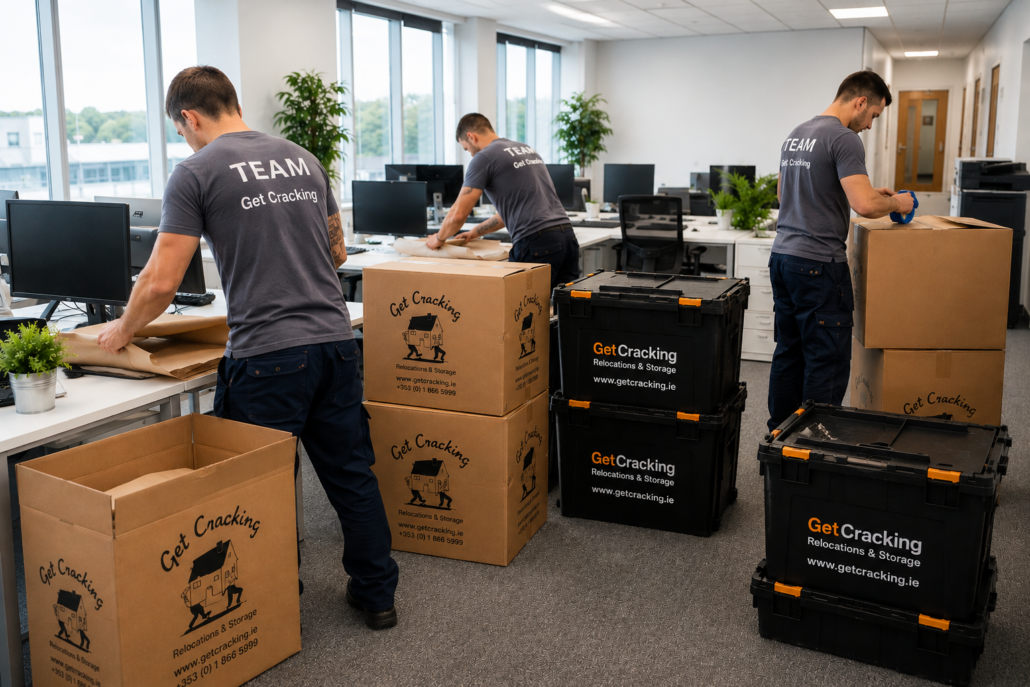
Moving Office Dublin 2026 | AI & Office Relocation
The office being moved in 2026 is very different from the office businesses were moving ten years ago.
Filing cabinets are increasingly being replaced by digital records and cloud systems. Permanent desks are sharing space with hybrid workstations. Meeting rooms now contain large screens, cameras, microphones and video-conferencing technology, while employees may divide their working week between home and the office.
For businesses moving office Dublin in 2026, this means relocation planning has changed too.
A modern office relocation is no longer simply about moving desks, chairs and boxes from one building to another. Businesses need to consider technology, cybersecurity, hybrid working, business continuity, smart-office equipment, furniture, storage, building access and how quickly employees can become operational at the new location.
Choosing the right office relocation company is therefore just as important as choosing the new premises.
Get Cracking Relocations & Storage provides commercial and office relocation services in Dublin, throughout Ireland and internationally, including planning, packing, office contents handling and storage.
If you are planning an office move, request an office relocation quote from Get Cracking.
Moving Office in Dublin Has Changed in 2026
The basic objective of an office move remains the same: move the business safely and get employees working again as quickly as possible.
What has changed is what the modern office contains and how employees use it.
A traditional office relocation may once have centred around:
- Desks
- Chairs
- Filing cabinets
- Desktop computers
- Telephones
- Paper records
A modern workplace may now include:
- Laptops and docking stations
- Multiple monitors
- Video-conferencing systems
- Large meeting-room displays
- Interactive screens
- Smart-office equipment
- Wireless networking equipment
- Shared and hot-desking workstations
- Collaboration areas
- Specialist technology
- Secure digital and physical records
This changes how an office needs to be surveyed, packed, labelled, transported and reassembled.
The AI Era Is Changing the Workplace
Artificial intelligence is affecting how many businesses operate, but its impact on office relocation is not simply about using an AI tool to create a moving checklist.
AI and wider digital transformation are changing what businesses need from their physical offices.
Some companies are redesigning offices around collaboration rather than allocating a permanent desk to every employee. Others need more meeting rooms equipped for remote participants, additional screens and technology, or quieter areas for concentrated work.
Before moving office in Dublin, businesses should therefore ask whether the layout of the old office still reflects how the company works in 2026.
Do You Need to Move Everything?
An office relocation is an opportunity to reconsider what actually needs to travel to the new premises.
Ask:
- Are all existing desks still required?
- How many employees are normally in the office at the same time?
- Are large filing areas still necessary?
- Could archive material be stored elsewhere?
- Are meeting rooms being redesigned for hybrid meetings?
- Is old IT equipment being replaced?
- Which furniture will work in the new layout?
- Which items should be stored, reused or responsibly disposed of?
There is little benefit in paying to relocate furniture or equipment that the business intends to replace shortly afterwards.
Hybrid Working Changes How Offices Are Relocated
Hybrid working means some organisations now use their office differently.
Instead of one workstation for every employee, a business may use shared desks, team zones, collaboration spaces, meeting rooms and flexible working areas.
This can reduce the amount of furniture being moved, but it can also make planning more complicated because the new office layout needs to be understood before the relocation begins.
A modern office relocation plan should identify:
- Department locations
- Shared workstations
- Permanent workstations
- Meeting rooms
- Collaboration areas
- Reception
- IT and communications areas
- Storage areas
- Archive locations
Get Cracking’s own workplace policies recognise hybrid working as part of the modern working environment, making this an increasingly familiar consideration when planning office operations.
Cloud Technology Does Not Mean There Is Less IT to Move
Moving systems into the cloud can reduce dependence on some physical servers and paper records, but modern offices still contain significant amounts of technology.
Monitors, laptops, docking stations, network equipment, printers, screens, conferencing equipment and associated cables all need to arrive at the correct location.
For larger moves, every workstation should be clearly identified.
Separate the IT Move From the Furniture Move
The office relocation plan should clearly define responsibility for:
- Disconnecting equipment
- Packing equipment
- Transporting equipment
- Reconnecting equipment
- Network configuration
- Testing systems
- Data and cybersecurity responsibilities
A removal crew can transport properly prepared office equipment, but the company should not assume that its moving company is automatically responsible for configuring networks or reconnecting specialist systems.
Where an external IT provider is involved, their timetable should be coordinated with the removal schedule.
Cybersecurity Matters During an Office Move
An office relocation creates a period where computers, storage devices, paperwork and equipment may temporarily be outside their normal controlled environment.
Businesses should consider cybersecurity and information security as part of the relocation plan rather than dealing with them afterwards.
Particular attention may be required for:
- Laptops
- External drives
- Servers
- Network equipment
- Backup devices
- Confidential files
- HR records
- Financial documents
- Customer information
Businesses should decide who is authorised to handle sensitive equipment and records and maintain appropriate internal controls throughout the move.
Use Digital Inventories Before Moving Office
Technology can also make relocation planning easier.
Before moving day, businesses can create a digital inventory of furniture and equipment and photograph important items.
For a larger office, assets can be connected to departments, employees, floors or workstation numbers.
A simple digital inventory might record:
- Item description
- Current location
- Destination location
- Department
- Workstation number
- Whether dismantling is required
- Whether specialist handling is required
- Whether the item is moving, being stored or being disposed of
This helps the internal project team and removal company work from the same plan.
Office Crates and Labelling Still Matter in the AI Era
Technology may have changed the office, but good physical organisation remains one of the most important parts of a successful relocation.
Every office crate, monitor, chair, pedestal and furniture component should have a clear destination.
For larger moves, colour coding or numbering by department or floor can help the crew place items correctly without repeatedly asking for instructions.
Get Cracking provides office crate hire in Dublin for commercial relocations.
Useful labels can include:
- Employee or workstation number
- Department
- Destination floor
- Destination room
- Special instructions
A crate labelled Finance – Floor 3 – Workstation 18 is much more useful than one labelled simply Office.
Smart Offices Need Different Relocation Planning
Modern commercial buildings can contain technology that is integrated into the workplace itself.
This may include:
- Electronic access systems
- Smart meeting-room booking systems
- Video-conferencing equipment
- Large digital displays
- Interactive screens
- Security systems
- Automated lighting or environmental controls
Some of these systems belong to the building while others belong to the tenant.
Before moving, determine exactly which technology is being relocated and which remains with the existing premises.
Business Continuity Should Drive the Moving Plan
The objective should not simply be to empty the old building quickly.
The real objective is to have the business operating from the new premises with as little disruption as reasonably possible.
Identify the departments or functions that need to become operational first.
For many organisations these may include:
- Customer service
- Reception
- Sales
- Finance
- IT
- Management
- Operational teams
Once those priorities are understood, the relocation can be sequenced accordingly.
Weekend and After-Hours Office Relocations
For businesses that cannot afford significant downtime, an evening or weekend move can be worth considering.
A company may finish work on Friday, carry out the principal move during the evening or weekend, and aim to have the new office prepared before employees return.
This approach requires organisation before the weekend begins.
Crates need to be packed and labelled, furniture locations agreed, building access confirmed and IT responsibilities clearly allocated.
If you are considering an evening or weekend relocation, discuss the timetable when requesting the quotation so availability and access requirements can be reviewed in advance.
Phased Office Relocations for Larger Businesses
A company does not always need to move the entire operation at once.
Larger organisations can consider a phased move where different departments, floors or functions are relocated separately.
For example:
- Archive material may move first
- Surplus furniture can go into storage
- Non-critical teams may move next
- Business-critical departments can move later
This can help maintain business operations while the relocation is taking place.
Office Moves Across Dublin’s Main Business Areas
Businesses moving office Dublin may be relocating between very different types of commercial property.
Get Cracking assists with office and commercial moves throughout areas including:
- Dublin City Centre
- Dublin Docklands
- IFSC
- Grand Canal Dock
- Ballsbridge
- EastPoint
- Sandyford
- Leopardstown
- Citywest
- Park West
- Blanchardstown
- Ballycoolin
- Santry
- Blackrock
- Dún Laoghaire
A city-centre office with a restricted loading bay requires different planning from a business park with direct vehicle access.
Tell your mover about loading bays, underground car parks, lifts, security procedures, vehicle restrictions and building-management requirements as early as possible.
Storage Can Be Part of a Modern Office Strategy
A new office does not always need to accommodate everything from the previous premises.
A business may want to retain furniture or records without immediately filling the new workplace.
Short- or long-term storage can be useful during:
- Office downsizing
- Refurbishment
- Phased moves
- Temporary accommodation
- Fit-out delays
- Furniture replacement programmes
Discussing storage before the move allows collection, storage and eventual delivery to be incorporated into the wider relocation plan.
What About Old Office Furniture?
Moving office is also an opportunity to identify furniture and equipment that no longer suits the business.
Old desks, chairs, filing cabinets, shelving and other unwanted items should be identified before the removal begins.
Where possible, businesses can consider reuse or other appropriate options before disposal.
If unwanted furniture needs to be removed, tell Get Cracking during the quotation process so the items can be reviewed and an appropriate service agreed.
Waste Collection and Responsible Disposal
Waste collection and transportation is regulated in Ireland and should be handled by an appropriately permitted operator.
Get Cracking holds Waste Collection Permit reference NWCPO-23-12971-01.
Information about waste collection permits is available from the National Waste Collection Permit Office.
Not every type of material can be accepted for collection, so details of items requiring disposal should be provided before moving day.
Choosing the Right Office Relocation Company in 2026
A modern office relocation involves much more than desks and filing cabinets.
Businesses now need to think about laptops, monitors, video-conferencing technology, smart-office equipment, confidential information, hybrid workstations, business continuity, storage and building-management requirements.
That makes choosing the right office relocation company Dublin businesses can rely on particularly important.
The right mover should ask detailed questions before moving day rather than simply quoting for a truck and a crew.
Questions Your Office Mover Should Ask
A professional relocation company should want to understand:
- How many employees are moving?
- How many workstations are involved?
- How much downtime can the business tolerate?
- Is an evening or weekend move required?
- Will the move be completed in phases?
- Who is responsible for IT?
- Are there lifts or loading bays?
- Are there parking or vehicle restrictions?
- Is furniture dismantling required?
- Are office crates required?
- Is professional packing required?
- Is temporary storage required?
- Are there confidential records?
- Is specialist equipment involved?
- Does unwanted furniture need to be removed?
If a relocation company does not ask these questions, important parts of the move may not have been considered.
Do Not Choose an Office Moving Company on Price Alone
Price is important, but the cheapest initial quotation is not necessarily the lowest overall cost to the business.
A poorly planned move can potentially result in additional downtime, last-minute charges, misplaced equipment or employees arriving at an office that is not ready.
When comparing quotations, ask what is actually included.
Consider whether the quotation includes:
- Labour
- Vehicles
- Packing
- Crate hire
- Furniture protection
- Dismantling and reassembly
- Access requirements
- Evening or weekend working
- Storage
- Clearance requirements
Ask how unexpected changes or additional requirements will be handled.
A Site Survey Can Prevent Problems Later
For larger or more complicated office relocations, a site survey can be extremely useful.
It allows the mover to understand the actual furniture volume, equipment, access, lifts, stairs, parking and loading arrangements rather than relying entirely on assumptions.
The destination should be considered just as carefully as the existing office.
A beautifully designed new office is of little use to the removal crew if the loading bay cannot accommodate the vehicle or the boardroom table cannot fit through the lift.
Look at Experience and Professional Credentials
Businesses should also look at the professional background of the relocation company they are considering.
Get Cracking provides residential and commercial removals in Dublin, Ireland and internationally, together with relocation planning and packing services.
FIDI Accredited International Mover
Get Cracking is a FIDI-FAIM Accredited International Mover.
FIDI is an international alliance of professional moving and relocation companies, while the FAIM framework relates specifically to quality standards in international moving.
This is particularly relevant if an office move in Ireland is part of a wider international corporate relocation.
International Association of Movers – IAM
Get Cracking is also a member of the International Association of Movers (IAM).
IAM connects companies involved in international moving, forwarding and relocation services around the world.
FEDEMAC
Get Cracking is a FEDEMAC Commercial Member.
FEDEMAC represents the professional moving industry across Europe.
British Association of Removers – BAR
Get Cracking is also a member of the British Association of Removers (BAR).
BAR represents professional removals and storage companies and promotes standards within the moving industry.
International Office Relocations in the AI Era
Modern businesses are increasingly connected across multiple countries, and an office relocation may form part of a wider European or international restructuring.
An international corporate relocation may involve:
- Professional export packing
- Inventory preparation
- Road transport
- Sea freight
- Air freight
- Temporary storage
- Customs documentation
- Destination coordination
Learn more about Get Cracking worldwide and international relocation services.
Technology Helps, but Moving Still Requires People
AI can help businesses organise information, develop project plans, communicate with employees and analyse what will be required at the new workplace.
Digital inventories, floor plans and communication tools can also make a relocation easier to manage.
But ultimately, desks still need to be dismantled, screens need to be protected, crates need to be moved, vehicles need to be loaded and equipment needs to arrive in the correct place.
The technology may have changed. The importance of preparation, experienced crews and clear communication has not.
Frequently Asked Questions About Moving Office Dublin in 2026
Has AI Changed Office Relocations?
AI and wider digital transformation are changing how businesses use their workplaces. Hybrid working, cloud services, smart-office systems and technology-equipped meeting rooms can all affect what needs to be moved and how the new office should be organised.
Can AI Plan an Entire Office Move?
AI tools can assist with planning, schedules, inventories and communication, but a physical office relocation still requires accurate site information, experienced planning and trained crews.
Can We Move an Office Over a Weekend?
Evening and weekend moves may be possible depending on the size of the relocation, building access and crew availability. Discuss your preferred timetable when requesting a quotation.
Can Our Office Move Be Completed in Stages?
Yes. A phased office relocation can be useful for larger businesses that need to remain operational while departments or floors are moved separately.
Can Get Cracking Provide Office Crates?
Yes. Get Cracking provides office crate hire in Dublin.
Can Office Furniture Be Put Into Storage?
Yes. Storage can be incorporated into an office relocation where required, including during downsizing, refurbishment or phased moves.
Can Unwanted Office Furniture Be Removed?
This may be possible depending on the items and agreed service. Tell Get Cracking about unwanted furniture before the move so the requirements can be reviewed.
How Do We Choose an Office Relocation Company?
Look beyond the headline price. Consider the mover’s experience, planning process, packing and storage options, ability to deal with access restrictions, professional credentials and whether they ask enough questions to understand how your business operates.
Moving Office in Dublin in 2026? Start Planning Early
The modern workplace continues to evolve.
AI, hybrid working, cloud technology and smart-office systems may change what an office looks like, but the fundamentals of a successful relocation remain the same: understand what is moving, plan the sequence, protect the equipment, coordinate the people involved and choose a relocation company capable of managing the details.
When requesting a quotation, provide information about both premises, employee numbers, workstations, furniture, IT equipment, access, lifts, loading bays, storage requirements and the preferred moving timetable.
If your business is moving office in Dublin, Get Cracking Relocations & Storage can help plan and carry out the physical relocation while your team focuses on preparing the business for its new workplace.

 Get Cracking Limited
 Get Cracking Limited


 Get Cracking Limited



 © Get Cracking Limited
