Laboratory Removals Dublin | Planning a Cleanroom Relocation
Planning laboratory removals Dublin requires considerably more preparation than a standard office move. Laboratories and clean-room environments can contain sensitive equipment, calibrated instruments, specialist furniture and high-value machinery that need careful handling throughout the relocation.
A successful laboratory relocation therefore starts long before moving day.
Access routes, equipment requirements, packing methods, new laboratory layouts, transport, timing and responsibilities should all be agreed before equipment begins to move.
Get Cracking Relocations & Storage provides specialist commercial relocation services in Dublin and can assist organisations planning laboratory and clean-room moves.
For information about our dedicated clean-room service, visit our Pharmaceutical Cleanroom Relocations page.
Laboratory Removals Dublin Require Detailed Planning
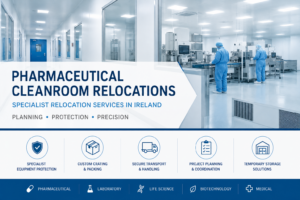
Specialist pharmaceutical clean-room relocation services in Ireland with Get Cracking Relocations & Storage.Specialist laboratory removals and clean-room relocation services in Dublin with Get Cracking Relocations & Storage.
A laboratory is very different from a normal office.
Instead of desks, chairs and filing cabinets, a laboratory relocation may involve sensitive instruments, laboratory benches, specialist equipment, refrigeration equipment, cabinets, computers and machinery.
Some equipment may be extremely sensitive to:
- Movement
- Vibration
- Tilt
- Impact
- Dust
- Moisture
- Temperature changes
- Incorrect lifting or handling
For this reason, a laboratory move should normally begin with a detailed assessment of what is being relocated and how each item needs to be handled.
Start With a Laboratory Relocation Survey
Before a laboratory move takes place, the moving company needs to understand both the existing site and the destination.
A pre-move survey can help identify:
- The quantity and type of equipment being relocated
- Equipment dimensions and weights
- Fragile or sensitive equipment
- Items requiring specialist packing or crating
- Items that may need manufacturer involvement
- Loading and unloading access
- Door and corridor dimensions
- Lift dimensions and weight limits
- Stairs or restricted access
- Vehicle access and loading areas
- The proposed layout at the new laboratory
- Whether the relocation needs to happen in phases
The more information available before moving day, the easier it is to prepare the correct equipment, crew, vehicles and packing materials.
Create a Detailed Laboratory Equipment Inventory
A clear equipment inventory is one of the most useful documents when planning laboratory removals in Dublin.
Each major item can be recorded with information such as:
- Equipment description
- Asset or identification number
- Current location
- Destination location
- Dimensions
- Approximate weight
- Packing requirements
- Special handling instructions
- Manufacturer requirements where applicable
This also gives both the organisation and relocation team a common reference when planning the sequence of the move.
Plan the New Laboratory Before Moving Equipment
Moving laboratory equipment without knowing exactly where it will be positioned at destination can create unnecessary delays.
Where possible, prepare the destination layout before the relocation begins.
This may include confirming:
- The final position of major equipment
- Available floor space
- Doorway and corridor access
- Floor loading limitations
- Electrical requirements
- Ventilation requirements
- Water or drainage connections
- Other specialist services
Your laboratory management team, equipment manufacturers, engineers and other specialist contractors may need to be involved in these decisions.
Laboratory Equipment Decommissioning
Before some scientific equipment can be moved, it may first need to be shut down, isolated or decommissioned correctly.
The organisation relocating the laboratory should determine who is responsible for this work.
For certain specialist instruments, the manufacturer or an authorized engineer may need to disconnect or prepare the equipment before the removal company handles it.
Similarly, commissioning, calibration and technical installation at destination should be allocated to the appropriate qualified party.
This division of responsibility should be agreed before moving day rather than decided while the relocation is underway.
Professional Packing for Laboratory Equipment
Laboratory equipment can require a higher level of protection than ordinary office furniture.
The appropriate packing method depends on factors including:
- Value
- Weight
- Dimensions
- Fragility
- Sensitivity to vibration
- Sensitivity to moisture or contamination
- The distance being transported
- The manufacturer’s handling requirements
Get Cracking’s clean-room relocation service can include specialist packing methods for sensitive and valuable equipment.
Depending on the equipment and agreed relocation plan, this may include specialist crates, vacuum packing and foil barrier protection.
Learn more about Get Cracking professional packing services.
Custom Crating for Sensitive Laboratory Equipment
Some equipment requires more protection than conventional wrapping or cartons can provide.
A purpose-made crate can be considered for delicate, valuable or unusually shaped equipment.
The crate can be designed around the dimensions and handling requirements of the particular item rather than trying to adapt a standard container.
This can be particularly useful when equipment is travelling over a longer distance or forms part of an international relocation.
Read more about custom crating for fragile and specialist items.
Tilt and Shock Monitoring
For certain sensitive equipment, simply knowing that an item arrived at destination may not provide enough information about how it was handled during the move.
Get Cracking’s specialist clean-room relocation service can use tilt and shock monitoring where appropriate to the agreed relocation protocol.
These devices can help indicate whether equipment has experienced movement outside agreed handling parameters during the relocation.
The requirement for monitoring should be identified during the planning stage.
Contamination Control During a Cleanroom Relocation
Cleanroom removals Dublin introduce another important consideration: contamination control.
Equipment travelling from one controlled environment to another may require specific procedures before it enters the destination clean-room.
The organization’s own clean-room procedures and applicable site requirements should determine how this is managed.
Depending on the project, considerations may include:
- Cleaning equipment before packing
- Protective wrapping or barrier materials
- Controlled staging areas
- Separating clean and non-clean equipment
- Removing external packaging before entering controlled areas
- Following destination clean-room entry procedures
These requirements should be incorporated into the relocation protocol before the move begins.
Plan the Equipment Removal Route
One of the most common mistakes in specialist relocations is concentrating on the equipment but overlooking the route required to remove it from the building.
Before moving a large laboratory instrument, check the complete route from its current position to the vehicle.
This can include:
- Laboratory doors
- Corridors
- Internal corners
- Passenger or goods lifts
- Stairways
- Loading bays
- External doors
- Vehicle access
The same assessment should be completed at the destination.
If equipment will not fit through the planned route, this needs to be identified early enough for an alternative solution to be arranged.
Protecting Floors, Walls and Buildings
Heavy scientific and laboratory equipment can also present risks to the building itself.
Depending on the equipment and site, the relocation plan may need to consider protection for:
- Floors
- Raised floors
- Doors
- Walls
- Lifts
- Corridors
- Loading areas
Weight distribution and the suitability of floors or lifts should be assessed by the appropriate responsible parties where heavy equipment is involved.
Laboratory Furniture Removals
Not everything in a laboratory is scientific instrumentation.
A laboratory relocation may also include:
- Laboratory benches
- Desks
- Office furniture
- Storage cabinets
- Chairs
- Shelving
- Computer equipment
- Archive material
- General workplace equipment
Combining specialist equipment relocation with ordinary commercial moving can make coordination easier where both are included within the agreed project scope.
Hazardous Materials, Chemicals and Samples
Laboratories can contain materials that cannot simply be packed into a standard removal vehicle.
Chemicals, gases, biological materials, samples, hazardous substances and regulated materials may be subject to specialist handling, storage or transport requirements.
These items should be identified during the planning stage.
Do not assume that regulated or hazardous materials can be transported as part of an ordinary laboratory removal.
The organisation should confirm the applicable requirements and determine whether an appropriately licensed specialist contractor is required.
Moving Refrigerated or Temperature-Sensitive Material
Temperature-sensitive research material can present additional challenges.
Before moving refrigerators, freezers or their contents, establish:
- Who is responsible for the contents
- Required temperature ranges
- Maximum permitted time outside controlled storage
- What monitoring is required
- Whether specialist temperature-controlled transportation is necessary
These requirements should be handled separately from assumptions about the general furniture and equipment relocation.
Minimising Laboratory Downtime
One of the most important objectives of a laboratory relocation is usually getting the organisation operational again as quickly as reasonably possible.
A move may therefore be completed in stages rather than relocating everything at once.
A phased plan might involve:
- Preparing the destination first
- Moving non-critical furniture and equipment
- Relocating individual departments or laboratory areas
- Moving critical equipment during an agreed shutdown period
- Allowing engineers to recommission equipment
- Completing the remaining relocation after essential operations resume
The best approach depends on the facility and its operational requirements.
Weekend and Out-of-Hours Laboratory Moves
Where operational continuity is important, some elements of a laboratory or commercial relocation may be scheduled outside normal working hours.
This should be discussed early because access, security, building management, engineers and other contractors may all need to be coordinated.
Get Cracking already undertakes commercial moves that are planned around customers’ operational requirements, including specialist projects such as pharmaceutical cleanrooms.
For broader commercial relocation information, see our Office Removals Dublin service.
Internal Laboratory Relocations
Not every laboratory relocation involves moving to another building.
Organisations may need to move equipment:
- Between laboratories in the same building
- Between floors
- Between departments
- Between buildings on the same campus
- Into temporary storage
- Into a newly constructed laboratory area
Internal relocations can still require detailed planning because access, equipment sensitivity and operational disruption remain important considerations.
Laboratory Removals Throughout Ireland
Although Get Cracking is based in Dublin, commercial and specialist relocation projects can extend beyond the city.
A laboratory move may involve relocation between facilities in different parts of Ireland or form part of a wider international project.
Longer-distance projects require additional consideration of transport time, packing, equipment security and delivery scheduling.
International Laboratory Relocation
Moving laboratory equipment internationally can add another layer of planning.
Depending on the destination, the project may involve:
- Export packing
- Specialist crating
- Detailed inventories
- Road, sea or air transport
- Customs documentation
- International moving partners
- Destination delivery coordination
Any technical, regulatory or import requirements relating specifically to the laboratory equipment should also be identified by the organisation before shipment.
Learn more about Get Cracking international relocation services.
Who Should Be Involved in Planning a Laboratory Move?
A successful laboratory move will often involve more than the moving company.
Depending on the project, the planning team may include:
- Laboratory management
- Facilities management
- Health and safety personnel
- Equipment manufacturers
- Service engineers
- IT teams
- Cleanroom specialists
- Building management
- Security teams
- The relocation project manager
Clearly defining each party’s responsibilities helps avoid confusion during the relocation.
Create a Laboratory Relocation Schedule
Once the equipment inventory and relocation strategy have been agreed, prepare a detailed schedule.
The schedule can identify:
- When equipment will be shut down
- When packing will begin
- Which equipment moves first
- Which route each item will take
- When vehicles will arrive
- Delivery sequence
- Who receives equipment at destination
- When engineers can begin recommissioning
The schedule should also allow some flexibility for specialist equipment that takes longer to prepare or install than expected.
Choosing a Laboratory Removal Company in Dublin
When comparing companies for a specialist laboratory relocation, do not look only at the transport vehicle.
Ask how the mover intends to plan and manage the complete relocation.
Useful questions include:
- Will the site be surveyed before the move?
- Who will manage the relocation?
- What packing methods are available?
- Can specialist crates be arranged?
- How will sensitive equipment be protected?
- Can tilt or shock monitoring be considered?
- How will inventories be managed?
- Can the move be completed in phases?
- Can storage be incorporated if necessary?
- How will access at both sites be assessed?
Professional Moving Standards
Get Cracking Relocations & Storage is a FIDI Affiliate and FAIM-accredited international mover, reflecting recognised professional standards for specialist, laboratory and international relocation projects.
Learn more about our professional accreditation on the FIDI Global Alliance website:
https://www.fidi.org/find-fidi-affiliate/get-cracking-relocations
Licensed Waste Removal
Where waste removal forms part of a relocation project, Get Cracking operates under Waste Collection Permit NWCPO-23-12971-01, supporting responsible and licensed waste collection in Ireland. Our permit can be checked through the National Waste Collection Permit Office (NWCPO) at https://www.nwcpo.ie/.
Get Cracking Cleanroom and Laboratory Relocations
Get Cracking Relocations & Storage provides commercial and specialist relocation services from Dublin.
Our dedicated clean-room relocation service is designed around detailed planning and agreed protocols for the equipment being moved.
Depending on the agreed project requirements, specialist protection can include vacuum packing, foil barrier bags, specialist crates and tilt or shock monitoring.
Each relocation should be assessed individually because laboratory environments, equipment and operational requirements vary significantly.
Read more about our Pharmaceutical Cleanroom Relocation service.
Frequently Asked Questions About Laboratory Removals Dublin
Can Get Cracking Move Laboratory Equipment?
Get Cracking provides specialist commercial and clean-room relocation services. The equipment and handling requirements should be assessed before the move so the appropriate relocation plan can be prepared.
Can You Move a Pharmaceutical Cleanroom?
Get Cracking provides a dedicated pharmaceutical clean-room relocation service with relocation planning and specialist equipment-protection options.
Can Laboratory Equipment Be Custom Crated?
Yes, custom crating can be considered for suitable fragile, valuable or specialist equipment depending on its dimensions and handling requirements.
Can You Monitor Equipment for Shock or Tilt?
Tilt and shock monitoring can be used for suitable clean-room relocation projects where this forms part of the agreed handling protocol.
Can Laboratory Removals Be Completed in Stages?
Yes. Depending on the project, a phased relocation may help an organisation manage operational downtime and coordinate technical teams.
Can You Move Hazardous Laboratory Chemicals?
Hazardous or regulated materials require separate assessment. They should not automatically be included in a standard laboratory removal. Tell the relocation team about these materials in advance so the appropriate requirements and responsibilities can be established.
Do Equipment Manufacturers Need to Be Involved?
For certain specialist or calibrated equipment, manufacturer or authorized-engineer involvement may be required for decommissioning, preparation, recommissioning or calibration. This should be confirmed before the move.
Do You Provide Laboratory Removals Outside Dublin?
Get Cracking provides commercial relocation services in Dublin, throughout Ireland and internationally. The requirements of a specialist laboratory relocation should be discussed and assessed before quotation.
Get a Quote for Laboratory Removals in Dublin
If your organisation is planning laboratory removals Dublin, a clean-room relocation or the movement of specialist scientific equipment, start planning as early as possible.
Provide information about the equipment being moved, both locations, access conditions, preferred move dates and any specialist packing or handling requirements.
The Get Cracking team can then review the project and discuss an appropriate relocation plan.
Request a Laboratory Relocation Quote
Get Cracking Relocations & Storage
Dublin, Ireland
Telephone: 01 866 5999
Email: info@getcracking.ie sales@getcracking.ie
 Get Cracking Limited
 Get Cracking Limited
 Get Cracking Limited
 Get Cracking Limited